Tuesday, July 17, 2012

On Camera Self Criticism
Shamelessly engage in humblebrag


CBS Anchor Charlie Rose set up a predictable Kobayashi Maru, when he asked President Obama what he considered his biggest mistake during the first term.  This is now such a predictable question that politicians should be prepared how to answer this no win question.  Deny there were mistakes and you appear unrealistically unaware.  Admit mistakes and you provide video for your opponent's attack ads.  Worse, admit problems but blame them on others and you give the impression of someone evading accountability.

I believe the first time this question was sprung on a President was during a Presidential News Conference in April 2004 with President George W. Bush.  It was an election year.   Bush clearly did not anticipate the question and for forty-three seconds he appeared honestly at a loss for thoughts and words.  While he admitted - in the abstract - that he was sure he had made mistakes, he declared that he couldn't think of one right at that moment.  It was the fact he couldn't name one specific mistake that created headlines.

Later, President Bush was more prepared when asked this question two years later.  He immediately identified his earlier remark "Bring it on" when publicly talking about the Iraqi terrorist insurgents.  

It should then have come as now surprise to President Obama when Charlie Rose asked this same question.  President Obama seemed better prepared.  


When I think about what we’ve done well and what we haven’t done well,” the president said, “the mistake of my first term – couple of years – was thinking that this job was just about getting the policy right. And that’s important. But the nature of this office is also to tell a story to the American people that gives them a sense of unity and purpose and optimism, especially during tough times.
It’s funny – when I ran, everybody said, well he can give a good speech but can he actually manage the job? And in my first two years, I think the notion was, ‘Well, he’s been juggling and managing a lot of stuff, but where’s the story that tells us where he’s going?’ And I think that was a legitimate criticism.'"
Whether it was politically best choice to identify his inability to tell a story as his greatest mistake, the response perfectly fits the art of humblebrag.  Oliver Burkeman explains, a humblebrag is the art of answering in away that makes you look pretty darn fantastic.  "What is my biggest fault," a job seeker says.  "It must be that I work too hard."  Obama declares his policies and their implementation as spot on and flawless, but then places the blame on his inability to "tell a story." The reaction to this searing self-confessional makes clear that the answer needs to be refined to not trivialize the proffered mistake.


Thursday, July 12, 2012

Political Marketing: Campaign Icons & Logos

Bringing Branding to Politics


Marketing is the combination of the art of psychology applied to the economics of buying and selling.  Students are taught that marketing involves deliberate decisions about product, placement, price, packaging, promotion, and people.  Political campaigns have always brought along songs, catch phrases, and themes.  "I like Ike" is perhaps the most memorable catch phrase.  


The gold standard of political icons is the Obama icon.  It conveys so many messages of Obama, the Sun, heartland, patriotism, and a new day of hope.  It is perfect and perhaps that explains why he uses it often and everywhere.  It is the first "non-name" logo for a Presidential Candidate that I can recall.  (If I am wrong please let me know in the comments.)

Campaign logos, or icons, have recently transformed from simple exercises in typesetting and graphic arts into a critical element of the campaign that conveys not just the identity, but the message of the candidate.  Bill Whittle has an excellent YouTube commentary on icons and their power in politics.


Mitt Romney has started to incorporate a message with his logo.  If you have to add a message to your logo, it may be a tacit admission that your logo doesn't convey the theme.  


It used to be so simple. The button and sign had to convey the candidate's name and that was it.

As we move forward in time, the campaign logo had a few basic rules:  (1) Prominently display the candidate's name; (2) Use Red, White and Blue - or some combination; and (3) Use images of stars, stripe or eagles or other such USA visuals.


Bill Clinton incorporated all of these elements in his campaigns for president.  His campaign logo is patriotic and incorporates a star in his name.  Note the use of angles, a road up so-to-speak - giving a dynamic "moving" quality to the logo.


In the 2000 election the Gore campaign is still in typesetting mode having a shooting star.  Further complicating the logo is that Vice-Presidential Candidate Joe Lieberman's name is so much longer leading to speculation that perhaps you should choose a running mate with a name not twice the size of your own.


During the 2004 campaign George W. Bush used the American Flag (no subtlety here) next to either his name or "W."  Again, just incorporating a little graphic arts to spruce things up.


Hillary Clinton continued the trend in her failed campaign for the nomination for the 2008 Democratic nomination.  Reminiscent of the Eisenhower campaign, she adopted the first-name basis, perhaps to distinguish her from prior Bill "Clinton" campaign messages.

Campaign and candidate icons and branding are here to stay and how well a campaign creates a logo indicates the sophistication and integration about its attention to detail with the campaign message.


Tuesday, July 10, 2012

Re-Framing The Issue
Make the topic about what you want it to be - not what it is to others

Following the highly anticipated Health Care Decision by the United States Supreme Court, President Obama took to the cameras and said, "Good afternoon. Earlier today, the Supreme Court upheld the constitutionality of the Affordable Care Act — the name of the health care reform we passed two years ago. In doing so, they’ve reaffirmed a fundamental principle that here in America - in the wealthiest nation on Earth - no illness or accident should lead to any family’s financial ruin.  (Emphasis Supplied)

Yet that wasn’t the issue or the principle before the Supreme Court.  The Decision itself states at the outset,  "We do not consider whether the Act embodies sound policies. That judgment is entrusted to the Nation’s elected leaders. We ask only whether Congress has the power under the Constitution to enact the challenged provisions … In this case we must again determine whether the Constitution grants Congress powers it now asserts, but which many States and individuals believe it does not possess."


Focusing just on the individual mandate, that is, the law’s requirement that each individual purchase health insurance, the issue, and therefore the principle before the United States Supreme Court was really a simple question: What Part of the Constitution did Congress rely upon to pass the individual mandate?


 It is a question that perplexed even elected members of Congress: 


In the oral arguments before the Supreme Court on the mandate, there were only two possible arguments.  The first, and primary argument of the government was that Congress’ power to regulate interstate commerce gave them the power to require participation in the market.  The second, almost an after thought argument, was that Congress’ power to tax gave it the power to “take” money from individuals who did not purchase insurance.  It was the latter argument that prevailed. 

Mitt Romney provided a more nuanced reaction to the decision,  “Let's make clear that we understand what the court did and did not do," he said. "What the court did today was say that Obamacare does not violate the Constitution. What they did not do is say that Obamacare is good law or that it's good policy."

 With such parsing, he may have scored points with Constitutional Scholars and other intellectual purists, but he lost an opportunity to speak to the average voter who, with Obama’s encouragement, may consider the decision to be an endorsement of the his political aims.

Saturday, June 30, 2012

Personal Holiday Fundraising

How the Internet has brought Politicians into our family Celebrations

The Obama Campaign recently introduced (see below) a new facet of fundraising effort that is a continuation of widely expanding genre of raising money that I call Personal Holiday Fundraising.

Political campaigns are about mass communication, and that requires money always.  It is the bane of reality.  Before the late nineties, political campaigns had to rely upon three tried-and-true methods of fundraising: (1) One-to-one personal requests where the candidate or a surrogate would personally ask another for a donation; (2) The Campaign Fund Raiser - such as a dinner (with a visiting crowd-drawing guest); and (3) the direct mail request.  

Email and the internet have not changed those tools, but they have certainly added some interesting new flexibility in tailoring and targeting the message.  Previously it may have been cost effective to do a fundraising letter (with the stamp, the hand written address,etc) to mark or celebrate a birthday, but it was very limited.  I recall seeing a few letters trying to raise money for Reagan's Birthday, but that was it.

Now with the internet, political candidates insert themselves into all of our personal holidays such as birthdays, Father's Day, Mother's Day, and now weddings.  These pitches seek to acheive four critical goals for any electoral campaign:  (1) Connect the candidate with voters on personal issues; (2) Raise Money; (3) Create engagement by having voters "sign" the card, or send a message of support; and (4) develop a database of active supporters.

Mothers' Day

The Obama campaign continues with a near flawless integration of campaign messages and personal holiday fundraising with three efforts.  

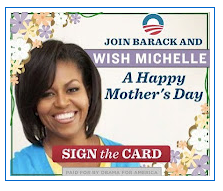
(1) Sign the Card.  Voters are asked to "join" the Presdient and sign the Mother's Day Card.  When people click on it they are asked to put in personal information (to build the database) and also for a donation.

(2)  Get a Tweet from the President.  This is something new - where grassroots activists who get five or more contributions attributed to them will be entered in for a chance to have the President tweet to your Mom on Mother's Day.  These sort of promotions are really new in fundraising and thus far incredibly successful. 

(3) The Mother's Day Video.  Starting off with the courageous introduction that "I think it is important to  recognize that Mom's come in all different shapes and sizes..."  The video flawlessly intertwines the political messages of inclusiveness, equal pay, medical care with messages of hearth and home.

Tuesday, June 19, 2012


Concentrated Benefits versus Diffused Costs:  How a Minority Political Interests Win

Interest groups may succeed in obtain political benefits by spreading the expense of the broader political base.  The benefits motivate the interest group, while the relatively small “expense” fails to have a similar motivating effect upon the broader political base.  Examples include:  School Board Elections, School Bond and Tax Increase Election, and Public Financing of Sports Stadiums.  In this case “benefits” could be monetary, regulatory, or public assistance.  

In politics, as in economics, incentives matter.  It follows that benefits given to a smaller group of individuals provide a greater incentive to each individual to support the measure.  If the cost of providing that benefit is spread out over a larger group of the populace - each individual faces a smaller incentive to fight against the measure.  University of Maryland’s Mancur Olson theorized in his first book The Logic of Collective Action: Public Goods and the Theory of Groups (1965) that motivating a group toward or against a particular action becomes increasingly difficult as the size of the group increases.  As Wallace Forman writes in his blog Commentarius, “self-interested voters rationally allow themselves to be robbed a penny at a time.” 

Smaller interest groups increase the odds of success when they are able to shift elections or referendums to non-traditional voting dates, for example school board and city counsel elections.  Individuals employed by school districts are highly motivated to take the time to vote compared to other members of body politic.

Wednesday, June 13, 2012

The First Casualty of the Campaign Political Lexicon

This site contains political campaign tactics, themes, and arguments as well as words and phrases that have become "terms of art" in the political world.  Inspired by WIlliam Safire's Political Dictionary and Sun Tzu's Art of War - I strive to create the online practical guide to marketing politics in the 21st Century.

I bring four qualifications to the table.  (1) I have a Bachelors in Marketing; (2) I have past modest paid political campaign employment experience; (3) I am a practicing attorney involved with litigation; and (4) A love of logic, rhetoric, and the turn of the phrase.

I will update this blog every week at a minimum drawing up current campaign events, so please subscribe and I look forward to your comments.